

In the high-stakes world of global finance, precision is everything. A misplaced decimal point is a disaster; a misunderstood “accrual” or “liability” in a board meeting can be a career-ending oversight. If you are a financial professional working in an international environment, “good enough” English isn’t enough. You need the specific, technical fluency required to navigate complex audits, tax regulations, and quarterly earnings calls.
This English for finance and accounting masterclass provides the roadmap you need to transition from basic proficiency to professional mastery.

Why General English Isn’t Enough for Finance
Financial English is a distinct dialect. While a standard course teaches you how to order at a restaurant, a finance masterclass teaches you how to explain EBITDA fluctuations to a skeptical stakeholder.
In a real workplace scenario, you aren’t just “talking”; you are:
- Defending valuation models.
- Explaining discrepancies in balance sheets.
- Negotiating credit terms with international lenders.
To succeed, you must move beyond vocabulary lists and focus on the application of language in [How to Improve Business English Fast].
The 3 Strategic Pillars of an English for Finance and Accounting Masterclass
1. Precision in Financial Reporting
Accuracy is the cornerstone of accounting. Whether you are working with IFRS or GAAP, you must be able to describe line items with total clarity.
- The Challenge: Differentiating between “revenue,” “turnover,” and “top-line growth” in a way that aligns with your region’s standards.
- The Solution: You should start structured Business English training that focuses specifically on corporate reporting and international accounting standards.
2. High-Stakes Presentation Skills
Data is useless if you cannot tell the story behind the numbers. If you are leading a [Business English for Meetings Guide] session, you need “signposting” language to guide your audience through complex charts.
- Key Phrases: “If you look at the YOY growth,” “This trend is driven by,” and “Let’s drill down into the operational expenses.”
3. Professional Skepticism and Inquiry
For auditors and controllers, the ability to ask “tough” questions politely is vital. Using modal verbs (could, might, would) allows you to challenge figures without sounding confrontational.
- Example: “Could you clarify the basis for this asset valuation?” instead of “This valuation is wrong.”
An English finance and accounting Playbook
Part 1: Reporting & Performance Metrics
1. EBITDA (Earnings Before Interest, Taxes, Depreciation, and Amortization)
- Strategic Use: Use this to discuss operational profitability before accounting for financing or regulatory environments.
- Executive Phrasing: “If we look at the EBITDA margin, we see a healthy underlying operational performance despite the heavy tax burden this quarter.”
2. Accruals
- Strategic Use: Vital for discussing the timing of revenue and expenses. It demonstrates a sophisticated understanding of the matching principle.
- Executive Phrasing: “We need to ensure all year-end accruals are meticulously documented to avoid audit discrepancies.”
3. Variance
- Strategic Use: The primary term for explaining the gap between planned (budgeted) and actual results.
- Executive Phrasing: “The unfavorable variance in operational costs was driven by unexpected supply chain disruptions in Q2.”
4. Liquidity
- Strategic Use: Use when discussing a company’s ability to meet short-term obligations.
- Executive Phrasing: “Maintaining a robust liquidity position is our top priority as we navigate this period of market volatility.”
5. Leverage
- Strategic Use: Refers to the ratio of debt to equity.
- Executive Phrasing: “Our current leverage ratio is well within our covenants, allowing us flexibility for future M&A activity.”
Part 2: Audit & Compliance
6. Materiality
- Strategic Use: The threshold at which missing or incorrect information would impact the decision-making of a stakeholder.
- Executive Phrasing: “While there was a discrepancy in the petty cash, it does not meet our materiality threshold for a formal restatement.”
7. Internal Controls
- Strategic Use: Use to reassure stakeholders about the integrity of financial data and risk management.
- Executive Phrasing: “We are currently strengthening our internal controls to mitigate the risk of fraud in our overseas subsidiaries.”
8. Reconciliation
- Strategic Use: The process of ensuring two sets of records (usually bank vs. ledger) match.
- Executive Phrasing: “The month-end reconciliation process has been streamlined to reduce our closing time by three days.”
9. Liability
- Strategic Use: Distinguish between current (short-term) and non-current (long-term) obligations.
- Executive Phrasing: “We have restructured our long-term liabilities to take advantage of the current low-interest-rate environment.”
10. Audit Trail
- Strategic Use: Demonstrates transparency and readiness for scrutiny.
- Executive Phrasing: “Every transaction in this ledger has a clear, digital audit trail that can withstand a rigorous external review.”
Part 3: Strategic Finance & Growth
11. Top-Line vs. Bottom-Line
- Strategic Use: “Top-line” refers to gross sales/revenue; “Bottom-line” refers to net income.
- Executive Phrasing: “While our top-line growth was impressive, we must focus on bottom-line efficiency to satisfy shareholders.”
12. Working Capital
- Strategic Use: The difference between current assets and current liabilities; measures operational efficiency.
- Executive Phrasing: “By optimizing our inventory turnover, we have freed up significant working capital for reinvestment.”
13. Asset Valuation
- Strategic Use: Crucial for M&A or balance sheet strength discussions.
- Executive Phrasing: “The recent asset valuation indicates a significant appreciation in our real estate portfolio.”
14. Capital Expenditure (CapEx)
- Strategic Use: Money spent by a company to acquire or maintain fixed assets.
- Executive Phrasing: “Our CapEx budget for the next fiscal year is focused heavily on digital transformation and automation.”
15. Dividend Yield
- Strategic Use: Used specifically in investor relations to discuss the return on investment.
- Executive Phrasing: “We aim to maintain a competitive dividend yield to attract and retain long-term institutional investors.”
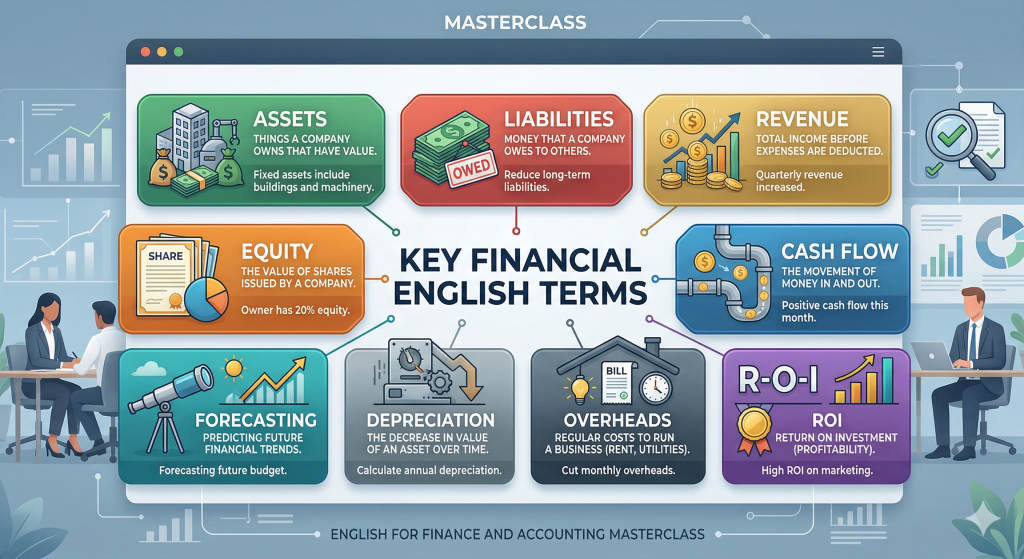
Key Financial English Terms
| Term | Simple Definition | Example Sentence |
| Assets | Things a company owns that have value. | “Our fixed assets include buildings and machinery.” |
| Liabilities | Money that a company owes to others. | “We need to reduce our long-term liabilities.” |
| Revenue | Total income before expenses are deducted. | “Quarterly revenue increased by 10% this year.” |
| Audit | An official inspection of financial accounts. | “The external audit will begin next Monday.” |
| Equity | The value of shares issued by a company. | “The CEO owns 20% of the company’s equity.” |
| Cash Flow | The movement of money in and out of a business. | “We are experiencing a positive cash flow this month.” |
| Forecasting | Predicting future financial trends. | “Financial forecasting helps us plan next year’s budget.” |
| Depreciation | The decrease in value of an asset over time. | “We must calculate the annual depreciation of our fleet.” |
| Overheads | Regular costs to run a business (rent, electricity). | “We are looking for ways to cut our monthly overheads.” |
| ROI | Return on Investment (profitability). | “The marketing campaign had a very high ROI.” |
Download the 1-Page Practice Worksheet (PDF)
Real Workplace Scenarios
Presenting the Budget:
- Scenario: Explaining why a department needs more funding.
- Sample Phrase: “Based on our projections, we require an additional 5% to cover rising operational costs.”
The Audit Meeting:
- Scenario: Answering an auditor’s question about a specific transaction.
- Sample Phrase: “Could you please clarify which ledger entry you are referring to? I will pull up the supporting documentation.”
Chasing Overdue Invoices:
- Scenario: Writing a polite but firm email to a client.
- Sample Phrase: “According to our records, invoice #402 is now 15 days overdue. We would appreciate prompt payment.”
D. Common Mistakes in Financial English
- Wrong: “The costs increased to 5%.” (If the growth was 5%)
- Correct: “The costs increased by 5%.”
- Wrong: “We have many economical problems.”
- Correct: “We have many economic problems.” (Economical means “saving money”).
- Wrong: “I am responsible of the accounts.”
- Correct: “I am responsible for the accounts.”
- Wrong: “The company loosed money.”
- Correct: “The company lost money.”
Top Platforms for Your English for Finance and Accounting Masterclass
To achieve the level of nuance required for finance, self-study is rarely sufficient. You need feedback from experts. Here are the top three platforms to accelerate your progress:
| Feature | British Council | Preply | italki |
| Best For | Structured, curriculum-led learning | Dedicated 1-on-1 coaching | Flexible, specialized tutors |
| Format | Small groups or private | Private 1-on-1 | Private 1-on-1 |
| Specialization | Corporate & Business | High (Search for “Finance”) | High (Search for “Accounting”) |
| Flexibility | Set schedules | High | Very High |
The English for Finance and Accounting Masterclass: The Structured Approach
If you prefer a proven framework and a prestigious certification to add to your LinkedIn profile, this is the gold standard. Their courses are designed by pedagogical experts to ensure you hit specific milestones.
Action: Start structured Business English training with the world’s English experts.
The English for Finance and Accounting Masterclass: The Targeted Skill-Builder
If you have a specific deadline—such as an upcoming audit or a job interview at a “Big Four” firm—Preply allows you to select tutors who have actual backgrounds in finance or CPA qualifications.
Action: Book 1-on-1 lessons with a tutor who understands your specific niche.

Mastering the Audit Trail: Professional Email Excellence for Finance
In the global financial sector, your digital footprint is often the primary basis for your professional reputation. Whether you are managing high-stakes tax queries or chasing a late payment from an international client, your email performance dictates how quickly capital moves and how effectively risk is managed.
To complement your technical mastery of the English for finance and accounting masterclass, you must also master the “diplomatic friction” of professional correspondence. Explore our specialized guides to refine your written authority:
- How to Say No Professionally in an Email: Essential for controllers and auditors who must deny budget requests or challenge expenditure without damaging vital stakeholder relationships.
- Polite Follow-up Email in English: Learn the art of “professional persistence” to ensure your audit requests and invoice queries stay at the top of the pile without sounding aggressive.
- Professional Email Sign-offs: Close your correspondence with the exact level of authority and formality required for high-net-worth clients and regulatory bodies.
💡 Pro-Tip: The “Second Pair of Eyes” Strategy
Drafting a sensitive email regarding a compliance breach or a significant variance? Don’t hit send until you’ve verified the tone. Book a 1-on-1 session on Preply to have a specialized business tutor review your drafts and ensure your written English matches your executive seniority.
For a full suite of strategies on navigating the international inbox, visit our complete archive of English Tips for Professionals.

