Why conjunctions matter
Why coordinating conjunctions? In the world of global business, how you speak and write is very important. For professionals, moving from simple, short sentences to smooth, professional English is the best way to grow your career. According to the British Council’s research on English and employability, strong communication skills are consistently ranked as one of the top factors in career advancement. To do this, you must master these coordinating conjunctions. Conjunctions are “connecting words” that act like glue. They hold your ideas together so that your emails and reports make sense to your boss and clients.
What are Conjunctions and Why Do We Use Them?
A conjunction is a word that connects other words, phrases, or parts of a sentence. Think of them as bridges. Instead of saying “I finished the report. I sent the email,” you can say “I finished the report and sent the email.” For a comprehensive grammar reference, the Purdue Online Writing Lab (OWL) is an excellent resource.
Using these words is a smart move for your professional image. They help you:
- Save Time: You can combine two small thoughts into one clear sentence.
- Show Logic: You can show if something happened because of a choice, a contrast, or a result.
- Sound Natural: Native speakers use these words constantly to keep a conversation flowing.
1. Coordinating Conjunctions: The “FANBOYS”
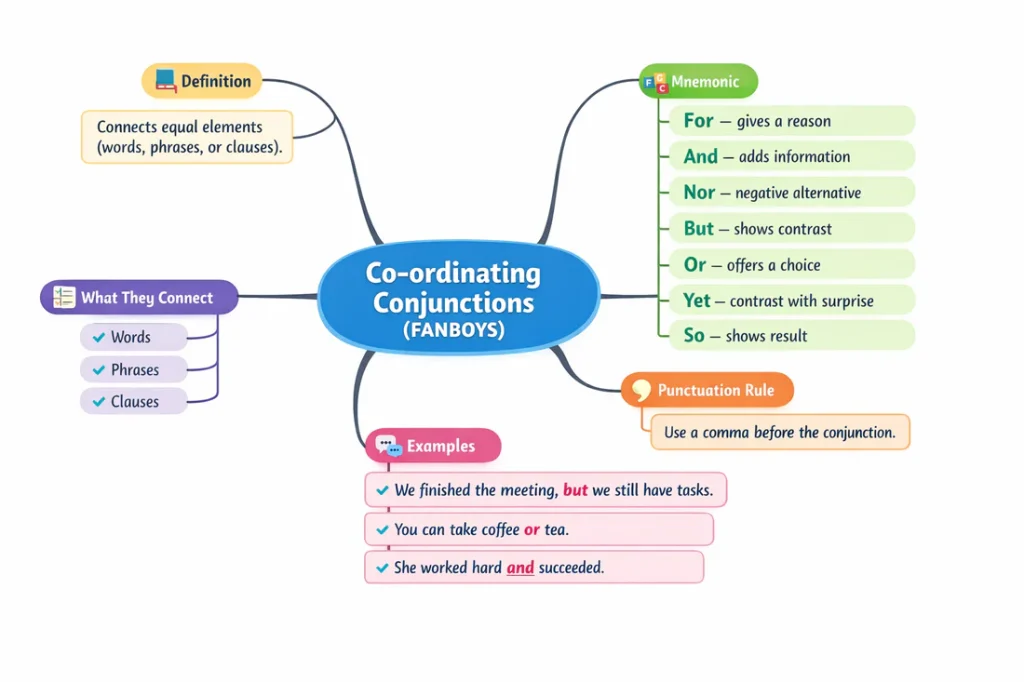
Coordinating conjunctions are the most basic connecting words. They connect two things that have the same importance. To remember them easily, use the word FANBOYS:
- For — gives a reason
- And — adds information
- Nor — adds a negative choice
- But — shows a contrast or difference
- Or — shows a choice
- Yet — shows a surprising contrast
- So — shows a result
Examples for the Office:
| Word | What it does | Example |
|---|---|---|
| And | Adds info | “I will finish the slides and I will send them to you.” |
| But | Shows contrast | “The plan is good, but it is too expensive.” |
| Or | Gives a choice | “We can meet on Monday, or we can meet on Tuesday.” |
| So | Shows a result | “The client was happy, so they signed the contract.” |
Important Punctuation Tip: If you connect two full sentences with a FANBOYS word, put a comma before the connecting word. The Cambridge Dictionary grammar section has additional examples and explanations.
2. Subordinating Conjunctions: Showing Relationships
These words are used when one part of the sentence depends on the other part to make sense. They are perfect for explaining “why,” “when,” or “under what condition” something happens.
You can remember many of these with the phrase “ON A WHITE BUS“:
- Only if, Once
- Now that
- Although, After, As
- While, When, Whereas
- How
- If, In case
- Though
- Even though, Even if
- Because, Before
- Until, Unless
- Since
How to use them in business:
- To show a reason: “The project was delayed because the team needed more time.”
- To show a condition: “We will start the project if the budget is approved.”
- To show a contrast: “Although the market is changing, our sales are still high.”
3. Correlative Conjunctions: The “Dynamic Pairs”
These words always work in pairs. They help you connect two equal ideas in a very balanced way.
- Both… and: “We need both your signature and the date.”
- Either… or: “You can either call me or send me an email.”
- Neither… nor: “Neither the manager nor the assistant was available.”
- Not only… but also: “The new software is not only faster but also easier to use.”
4. Transition Words (Conjunctive Adverbs)
If you want to sound like an executive or a manager, you should use “transition words.” These are more formal than FANBOYS.
| Category | Words to use | Professional Use |
|---|---|---|
| Addition | Furthermore, Moreover | Adding a second reason to your argument. |
| Contrast | However, Nevertheless | Acknowledging a problem before giving a solution. |
| Result | Therefore, Consequently | Showing that a decision was made because of data. |
| Clarification | In other words, Specifically | Explaining a difficult technical idea. |
Conjunctions in Professional Emails
Emails are the most common way to communicate at work. Using the right connecting words can make you sound polite instead of rude.
- Polite Requests: Use “if” to give people a choice. “I would be grateful if you could send the files today.”
- Giving Context: Use “because” or “regarding” to explain why you are writing.
- Offering Choices: Use “whether… or” to show flexibility.
A very common mistake in emails is the “comma splice”:
- Incorrect: “Thanks for your help, I really appreciate it.”
- Correct: “Thanks for your help. I really appreciate it.”
Conclusion: Your Path to Professional Fluency
Mastering conjunctions is the fastest way to improve your professional English. When you know how to use words like “However,” “Therefore,” and “Not only… but also,” people will respect your ideas more.
Here is your action plan:
- Watch your punctuation: Don’t forget the comma before FANBOYS when joining full sentences.
- Use pairs: Start using “both… and” or “either… or” in your next email to sound more balanced.
- Practice speaking: Book a lesson on italki or try the AI tools at the British Council.
By using these simple connecting words correctly, you will communicate with more clarity and confidence in every meeting.
Frequently Asked Questions
What are the 7 coordinating conjunctions in English?
The seven coordinating conjunctions are For, And, Nor, But, Or, Yet, and So — remembered by the acronym FANBOYS. They connect words, phrases, or independent clauses of equal grammatical importance.
What is the difference between coordinating and subordinating conjunctions?
Coordinating conjunctions (FANBOYS) connect two equal ideas. Subordinating conjunctions (because, although, if, when) connect a dependent clause to an independent clause, showing a relationship like cause, contrast, or condition.
How do conjunctions improve professional writing?
Conjunctions help you combine short, choppy sentences into smooth, logical statements. Using words like “however,” “therefore,” and “although” makes your emails and reports sound more polished, confident, and executive-level.
Can I use conjunctions at the beginning of a sentence?
Yes. Starting a sentence with “And,” “But,” or “Because” is grammatically acceptable in modern English. Professional style guides and publications regularly use this technique for emphasis and clarity.
What are correlative conjunctions?
Correlative conjunctions are pairs that work together to connect balanced ideas: “both… and,” “either… or,” “neither… nor,” and “not only… but also.” They are especially useful in professional presentations and formal writing.
Related Guides
Ready to expand your vocabulary further? Learn the 25 Essential English Collocations that professionals and IELTS candidates need to know.
If you prefer 1-on-1 practice with a real tutor, read our Italki Review 2026 to find the best online English lessons.
If you’re preparing for the IELTS, don’t miss our British Council IELTS Course Review 2026 — the most trusted exam prep platform available.