


Ielts collocations can make a big impact
Do you feel that your English is grammatically correct but still doesn’t sound natural — especially in meetings, emails, or IELTS exams?
You’re not alone. Many professionals and IELTS candidates struggle because they learn individual words, not how words naturally go together.
That’s where collocations come in.
Collocations are one of the fastest ways to improve fluency, sound professional, and increase your IELTS score — yet they’re often overlooked in traditional learning. If you’re serious about mastering them, structured courses like the British Council IELTS preparation course focus heavily on natural language use. let us look at 25 Essential IELTS collocations
What Are Collocations (and Why IELTS & Professionals Care)?
A collocation is a natural word combination that native speakers use automatically. The Oxford Learner’s Dictionary of Collocations is one of the best references for finding these patterns.
Examples:
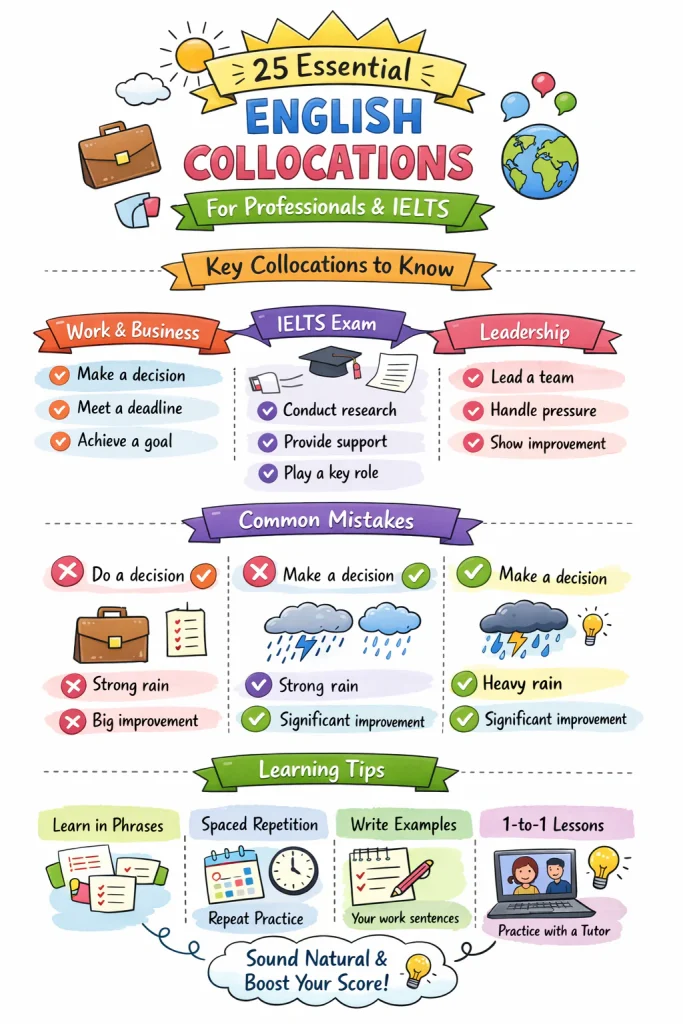
- ❌ do a decision → ✅ make a decision
- ❌ do a mistake → ✅ make a mistake
In IELTS, collocations directly affect your Lexical Resource score. Courses like British Council English Online teach you to use them naturally under exam conditions.
In the workplace, they affect how professional, confident, and fluent you sound. Practising collocations in 1-on-1 online English lessons with a native speaker is one of the fastest ways to build this skill.
25 Essential Collocations for Work & IELTS
Core Professional & IELTS Collocations
- Make a decision — We need to make a decision by Friday.
- Take responsibility — She took responsibility for the delay.
- Meet a deadline — The team met the deadline successfully.
- Gain experience — This role helped me gain valuable experience.
- Achieve a goal — The company achieved its growth goals.
Workplace & Business Communication
- Conduct research
- Reach an agreement
- Raise an issue
- Deliver results
- Take action
These collocations frequently appear in emails, reports, meetings, and presentations.
Advanced Collocations for IELTS Writing & Speaking
- Play a key role
- Face challenges
- Provide support
- Increase efficiency
- Maintain standards
These are especially powerful for IELTS Writing Task 2 and Speaking Part 3, where examiners look for precise and natural language. The British Council IELTS course includes dedicated practice for using collocations in timed writing tasks.
Leadership, Performance & Professional Growth
- Handle pressure
- Show improvement
- Make progress
- Address a problem
- Take into account
Common Professional Collocations
- Meet expectations
- Draw a conclusion
- Express an opinion
- Lead a team
- Deliver a presentation
Common Collocation Mistakes (That Lower IELTS Scores)
- ❌ Do a decision → ✅ Make a decision
- ❌ Strong rain → ✅ Heavy rain
- ❌ Big improvement → ✅ Significant improvement
These mistakes are extremely common among professionals — even at higher levels.
Collocations in IELTS: Real Examples
IELTS Writing Task 2
Governments must take responsibility and take action to address environmental challenges.
IELTS Speaking
In my previous role, I handled pressure, met deadlines, and played a key role in team projects.
How to Learn Collocations Faster (and Correctly)
The most effective methods are:
- Learn collocations in context, not as isolated lists
- Write work-related examples
- Use spaced repetition
- Practice speaking with feedback from a real teacher — platforms like italki let you book online English conversation practice with native speakers who can correct your collocations in real time
For structured IELTS preparation, the British Council online IELTS course combines collocation drills with mock exams and expert feedback — ideal if you’re targeting Band 7.0 or higher.
Frequently Asked Questions
Are collocations important for IELTS?
Yes. Strong collocations can significantly improve your Lexical Resource score, especially for Band 6.5–8. The official IELTS band descriptors explicitly reward “less common” and “natural” vocabulary combinations.
Are collocations grammar or vocabulary?
They are vocabulary patterns, but they strongly affect grammar accuracy and fluency.
How many collocations should I learn?
Focus on high-frequency collocations used in exams and professional contexts.
Do native speakers think about collocations?
No — which is why learners must study them deliberately.
Conclusion
If your goal is to sound natural, communicate confidently at work, and score higher in IELTS, collocations are one of the highest-ROI areas to focus on.
Start small, practice in real situations, and combine self-study with guided learning when possible.
Related Guides
Ready to expand your grammar further? Learn how to use co-ordinating conjunctions that professionals and IELTS candidates need to know.
If you prefer 1-on-1 practice with a real tutor, read our Italki Review 2026 to find the best online English lessons.
If you’re preparing for the IELTS, don’t miss our British Council IELTS Course Review 2026 — the most trusted exam prep platform available.

